


For e-commerce brands shipping across the United States, rising parcel costs can quietly erode profitability as order volumes grow. Shipping individual packages from a West Coast warehouse to East Coast customers through standard UPS or FedEx Ground routes exposes businesses to expensive long-distance shipping fees. Once direct-to-consumer (DTC) brands exceed 5,000 monthly orders, these costs can become increasingly difficult to sustain.
Zone skipping offers an alternative by consolidating individual packages into freight shipments and injecting them into regional carrier networks closer to customers. Understanding zone skipping vs. distributed warehousing helps businesses choose the right strategy for scaling efficiently.
How Carrier Zones Work and Why Transcontinental Shipping Is So Expensive
To understand why zone skipping works as an e-commerce fulfillment scaling option, it helps to understand how national carriers price distance in the first place.
UPS and FedEx divide the country into eight zones radiating out from a package’s origin. Zone 1 covers local delivery; Zone 8 covers the farthest possible distance, typically coast to coast. Rates increase with each zone, so a California warehouse shipping to a New York customer pays the maximum rate on nearly every order headed east.
A typical Zone 8 parcel doesn’t travel point to point. It bounces through four to six regional sorting hubs on its way across the country. Each touchpoint adds handling fees, sorting surcharges, and additional opportunities for delay or damage. The parcel is scanned, re-sorted, and reloaded multiple times before it ever reaches a local delivery truck, and brands absorb the cost of every one of those handoffs.
Carriers also price by dimensional weight (DIM), which calculates a shipping charge based on a package’s volume rather than its actual weight. Lightweight but bulky items, like apparel in boxes or packaged home goods, get penalized twice: once for distance, once for size. Combined with the multi-hub penalty, this is exactly why knowing how to cut shipping costs is important for scaling brands rather than a nice-to-have optimization.
The 3-Step Zone Skipping Pipeline
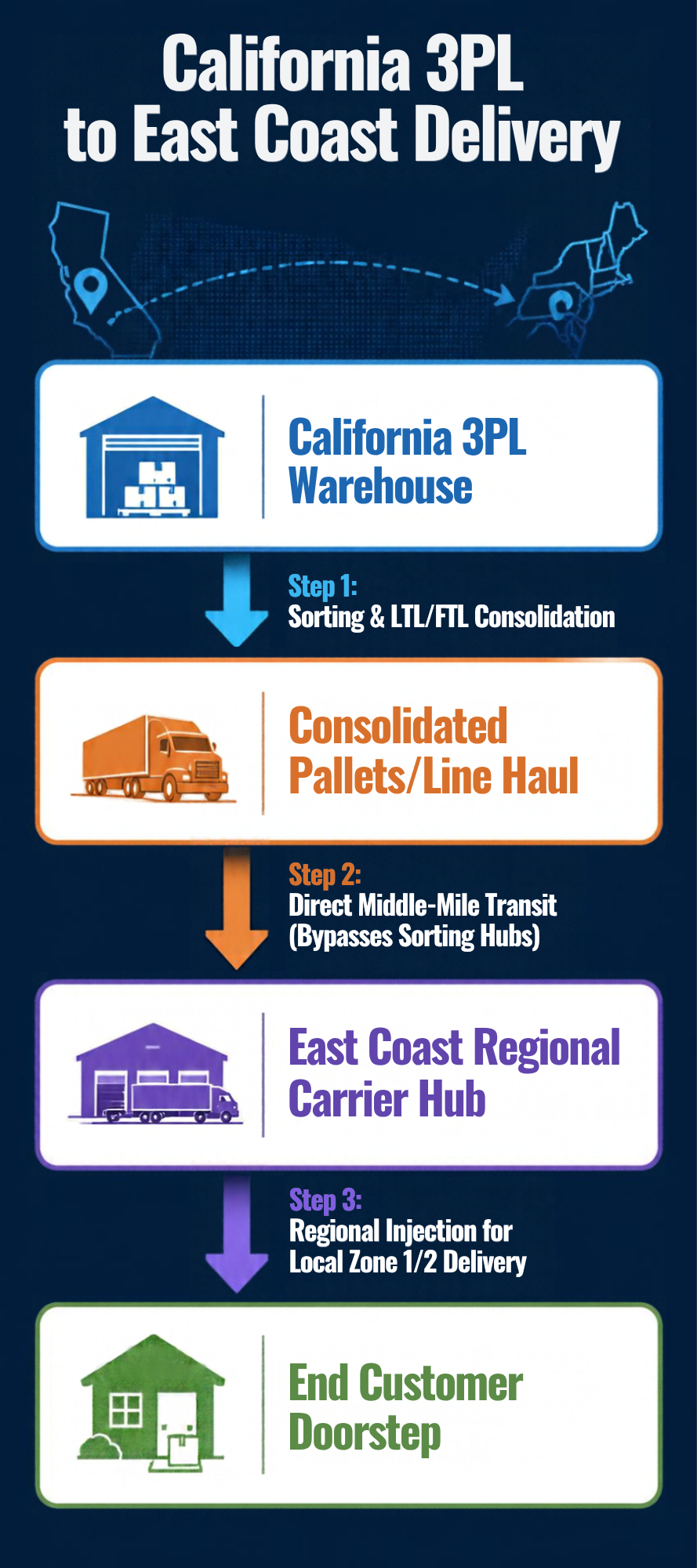
Here’s how a California-based third-party logistics (3PL) provider executes zone skipping, from warehouse shelf to East Coast doorstep.
Step 1: Consolidation and Pre-Labeling at Origin
Parcels are picked, packed, and pre-labeled with last-mile carrier shipping labels directly at the California facility. Packages bound for the same destination region, say the Tri-State area, are sorted into gaylords, palletized, and loaded onto a dedicated truck headed east.
Step 2: Direct Middle-Mile Line Haul
A full truckload (FTL) or less-than-truckload (LTL) carrier moves the consolidated freight directly across the country, skipping every intermediate parcel sortation hub a standard Zone 8 shipment would normally pass through. This single step eliminates most of the multi-hub penalty described above.
Step 3: Regional Injection for Last-Mile Entry
The truck unloads at a regional carrier sorting facility or a regional postal hub, such as a USPS Sectional Center Facility, on the East Coast. From there, parcels enter the local delivery network as Zone 1 or Zone 2 shipments. The carrier charges local rates because, from its perspective, the package is already local.
Additional Strategic Benefits Beyond the Shipping Rate
Cost reduction is the headline benefit, but zone skipping delivers advantages that extend past the invoice.
- Faster transit times. Bypassing intermediate sorting facilities eliminates the delays built into multi-hub routing, often cutting transcontinental delivery times by one to two days.
- Decreased damage and loss rates. Fewer touchpoints and fewer hub handoffs mean fewer opportunities for packages to be mishandled, misplaced, or damaged in transit.
- Access to regional parcel carriers. Zone skipping lets California brands tap specialized East Coast regional carriers, such as LaserShip/OnTrac or Veho, without leasing or staffing a physical warehouse on the opposite coast.
Operational Trade-Offs and Prerequisites
Zone skipping isn’t a fit for every brand, and it’s worth being honest about what it requires.
- Volume thresholds. Zone skipping only pencils out with sufficient regional order density, typically 1,000 or more orders per region per week, to consistently fill trucks. Below that threshold, consolidated freight runs at a loss.
- Transit schedule buffers. Trucks depart on fixed windows, for example Tuesdays and Fridays, which means brands need to manage customer expectations around order cutoff times rather than promising same-day dispatch on every order.
- Advanced WMS integration. A 3PL’s warehouse management system needs to auto-sort orders by destination region, pre-manifest bulk shipments, and dynamically generate carrier-compliant regional injection labels. Without this infrastructure, consolidation becomes a manual bottleneck rather than an automated process.
Final Thoughts: Distributed Inventory vs. Zone Skipping
So, is zone skipping cheaper than multi-warehouse fulfillment? It depends on what you’re optimizing for.
Distributed inventory (two-warehouse model: California plus New Jersey)
- Pros: the lowest possible transit times, with one-day ground delivery achievable on both coasts.
- Cons: split inventory costs, higher combined holding fees, and significantly more complex demand forecasting across two locations.
Single-node zone skipping (one warehouse in California)
- Pros: centralized inventory control, lower operational overhead, and simpler stock management since everything lives in one place.
- Cons: requires enough volume aggregation to justify truck departures, and slightly longer processing time before freight is released compared to shipping a parcel the moment it’s packed.
Choosing Your Scaling Strategy
Deciding between distributed warehousing vs. zone skipping isn’t always black and white. It depends on what stage your brand is at and what trade-off matters most right now. Zone skipping bridges the gap between single-warehouse simplicity and the low-cost, reasonably fast national delivery that growing DTC brands need to protect their margins. It gives brands the cost structure of a second warehouse without the overhead of running one.
For brands evaluating whether their current fulfillment setup can support the next stage of growth, Lean Supply Solutions can help assess order volume, regional density, and WMS readiness to determine whether zone skipping, distributed inventory, or a hybrid approach makes the most sense. Reach out to Lean Supply Solutions to talk through your scaling strategy.